Once in a lifetime California Condor experience

If you spend enough time outdoors eventually you get lucky to have ‘once in a lifetime’ wildlife experiences. We all remember these distinct events clearly and I know I won’t forget any of them for the rest of my life. This last weekend I was lucky enough to once again have one of these completely breath taking encounters.

Jeff Swanson, a good friend of mine and amazing landscape photographer, and I made the trek to Pinnacles National Monument to try and find some California Red-legged Frogs that JK let us know we could find there (thanks again Jake). Since we wanted to be at Bear Gulch Reservoir by sunrise that meant getting up at 3:00am. It was amazing to be the only people at the reservoir, it was completely tranquil and quiet (except beautiful bird calls of course!).

Bear Gulch Reservoir, Pinnacles National Monument

Bear Gulch Reservoir, Pinnacles National Monument

Since we didn’t have much luck finding adult frogs (we did find tadpoles which were awesome) and the light was getting harsher we decided to go for a little hike. First we encountered this amazing valley scene:
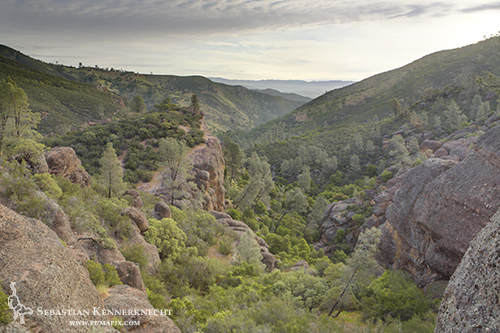
Bear Gulch, Pinnacles National Monument

Bear Gulch, Pinnacles National Monument

and then as we were higher up the trail we saw what I was hoping for the whole time while hiking, California Condors!

There were a couple of them perched in a tree so I left my gear with Jeff and went into stalking mode. I was still quite a bit away but got some images with the 100-400 telephoto lens when one of the birds flew right at me and landed on the rocks fifteen feet away from Jeff. I got back there as quickly and quietly as I could, hoping to be fast enough to get some shots but also not too fast to scare the bird away. The juvenile condor then decided it wanted a closer look at Jeff and I so he started hopping even closer (if you have ever seen a condor hop, you know how funny yet powerful it looks). My heart was pounding and my body was shaking from the excitement. I decided to grab some portrait shots while I had the chance, knowing that this was a rare event.
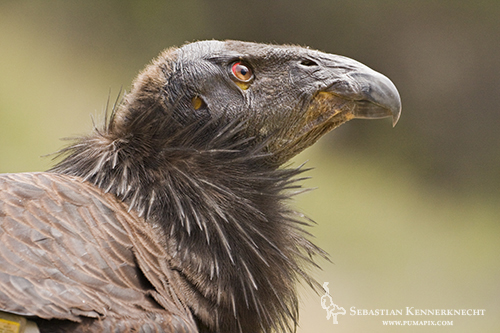
Juvenile male California Condor, Pinnacles National Monument
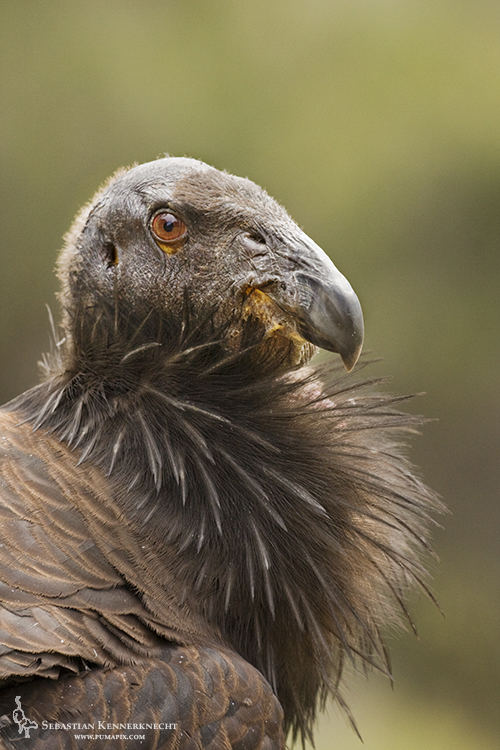
Juvenile male California Condor, Pinnacles National Monument
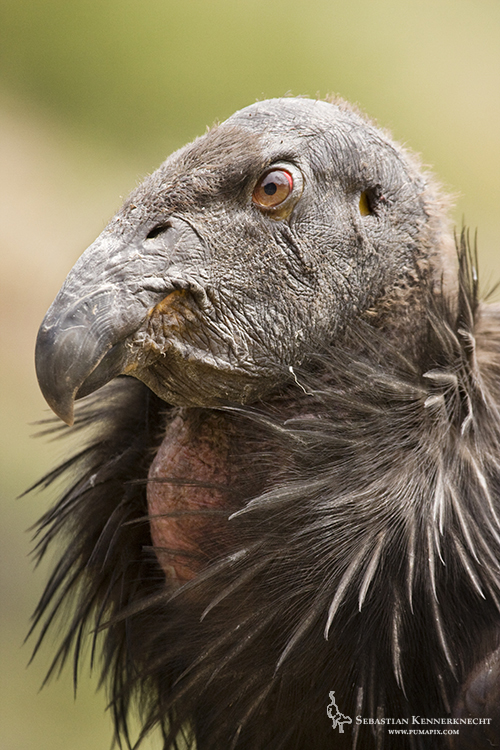
Juvenile male California Condor, Pinnacles National Monument

Juvenile male California Condor, Pinnacles National Monument

Juvenile male California Condor, Pinnacles National Monument

Juvenile male California Condor, Pinnacles National Monument

After having taken about 50 images, he decided to come even closer and was within 5 feet of us. I used my landscape camera and lens to get wide-angle views of him. Here is a shot as he seems to check us out.
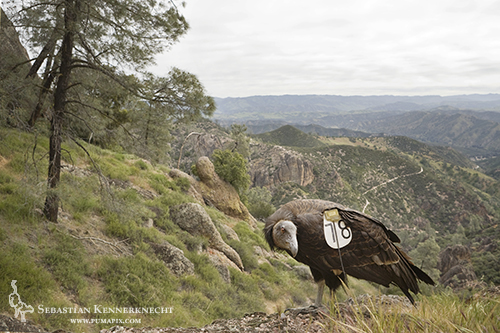
California Condor in Pinnacles National Monument

California Condor in Pinnacles National Monument

Just to give you an idea how close he is:
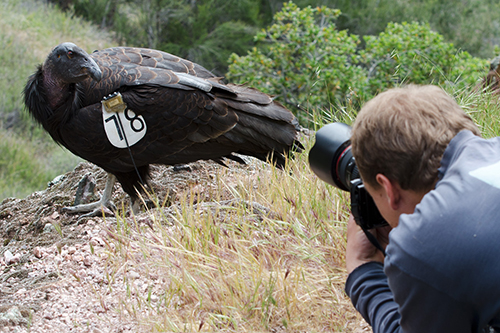
California Condor and me photographing it - Copyright Jeff Swanson

California Condor and me photographing it – Copyright Jeff Swanson

Finally, after about 20-30 minutes he decided to take off again. It was absolutely impressive as he spread his 9 foot wings to glide off.
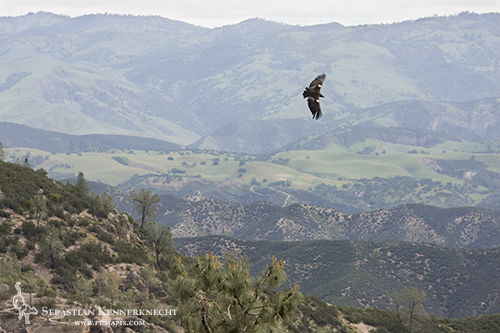
California Condor flying in Pinnacles National Monument

California Condor flying in Pinnacles National Monument

Jeff and I were sitting there for another 10 minutes saying how crazy that really was. What an experience!

Note: I keep using the term he, this is based on his tag that is attached to his wing. It looks like he is a three year old male (his pinkish throat pouch would seem to confirm this as well) born on April 23, 2008. All California Condors are tagged, even the wild born chicks are caught and fitted with a radio transmitter so if you see a bird without a number it is very very unlikely that it is a California Condor. You can find out about each condor’s life on the Condor Spotter site.

What was one of your most memorable wildlife experiences?

*If you are interested in purchasing any of the pictures displayed in this post, please check out my fine prints page for pricing.*
Identifying Puma Gender by Genital Spots

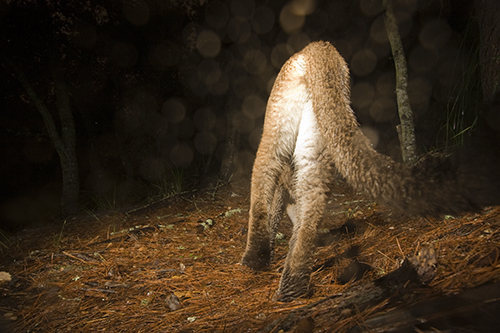
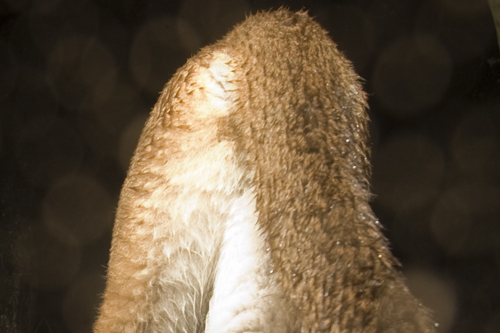
How do you identify the gender of a puma? This is one of those cases where I realize how little I know and how little experience I have in regards to Mountain Lions. I am sure an experienced puma biologists could look at the picture below and say, duh, that’s a male, or duh, that’s a female…well even after doing some more research I once again have no clue.

Mountain Lion Rear View

Mountain Lion Rear View

Mountain Lion Rear View Close Up

Mountain Lion Rear View Close Up

From Ken Logan and Linda Sweanor’s 2001 “Determining the Sex of Treed Cougars“:

“Male adult and subadult cats have a conspicuous black spot of hair, about 1 inch (2.5 cm) in diameter surrounding the opening to the penis sheath behind the hind legs and about 4 inches (10 cm) below the anus. The anus is usually hidden by the base of the tail. In between the anus and black spot is the scrotum, which is covered with light to dark brown hair and will usually appear as another dark spot.”

“Female adult and subadult cats do not have this conspicuous black spot of hair. The area is entirely covered in white hair. The anus is directly below the base of the tail and the vulva is directly underneath the anus. Both the anus and the vulva will usually be hidden by the base of the tail.”

So my guess would be female, but then there is that little amount of dark hair just to the left of the tail, but is that too close to the anus. What do you think?

Note: This image was taken two weeks (almost down to the minute) after the second image from the Aptos Mountain Lion Characters Post

Photographing at Bosque del Apache

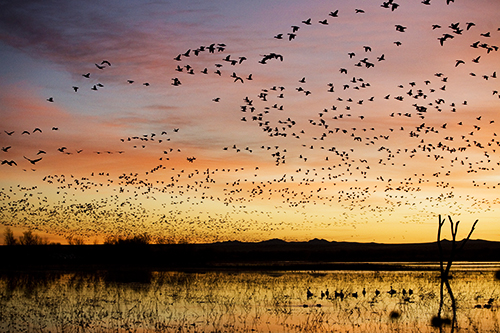
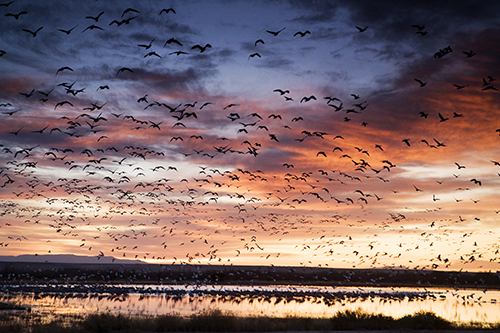
I always wanted to photograph the Sandhill Cranes and light geese (Snow Geese and Ross’s Geese) at Bosque del Apache National Wildlife Refuge in New Mexico. This desire arose from the passionate stories fellow nature photographers told me about the birds and the refuge. This included the “blast off”, an occurrence around sunrise when all of a sudden all the birds take off at once creating a colorful sky filled with birds.

When Kailani told me we had an open invitation from her friend in Albuquerque I knew it was time to visit. I arrived at the refuge on Saturday at 6:15am, with sunrise being at 7:15am. I was shocked to stand in line to get into the refuge. There was a line of wildlife photographers that stretched for a mile. This was wildlife photography I was not used to. It soon became obvious why this place is so popular. It provides easy access, birds that are not afraid of humans and spectacular action.

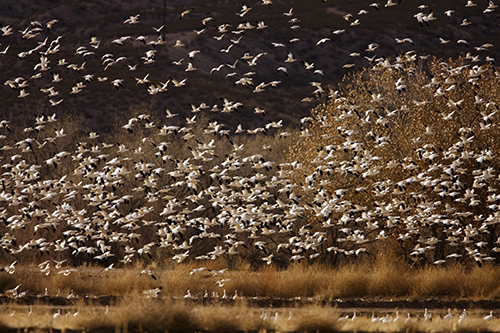
I was not let down by the blast off, wow was it just spectacular. The sound is truly like thunder, just amazing.

Snow Goose Blast Off at Sunrise

Snow Goose Blast Off at Sunrise

Snow Goose Blast Off at Sunrise

Snow Goose Blast Off at Sunrise

Snow Goose Blast Off

Snow Goose Blast Off

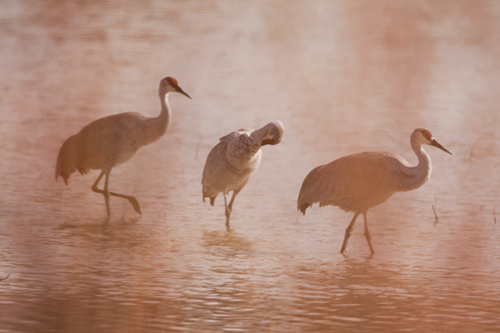
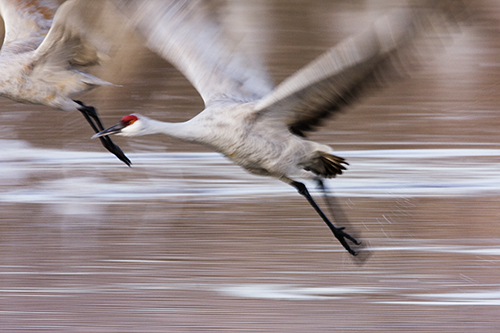
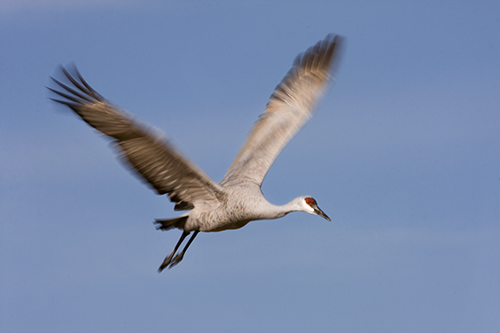
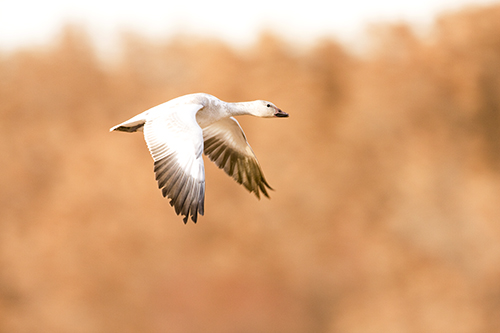
By Sunday I had figured out the routine, arrive early — this meant getting up at 2:30am in Albuquerque to arrive at the refuge at 4:30am to get the best flight deck spot. Then as soon as the flight deck take off is over head to either the feeding fields or the “crane ponds”. All of these places provide for amazing photographic opportunities. Due to the number of photographers it  forced me to create images that were different from the “standard” Bosque images, which I was quite thankful for in the end. I went for more abstract pictures including motion blurs and panning shots.

Sandhill Cranes behind Reeds

Sandhill Cranes behind Reeds

Sandhill Crane Taking Flight

Sandhill Crane Taking Flight

Sandhill Crane Flying

Sandhill Crane Flying

Snow Goose Flying

Snow Goose Flying

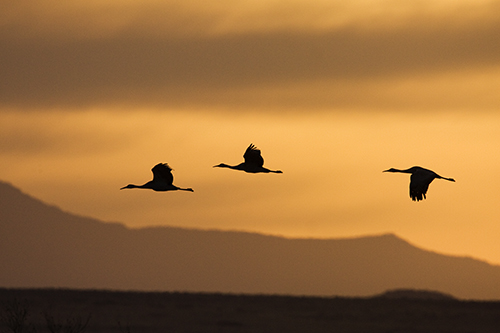
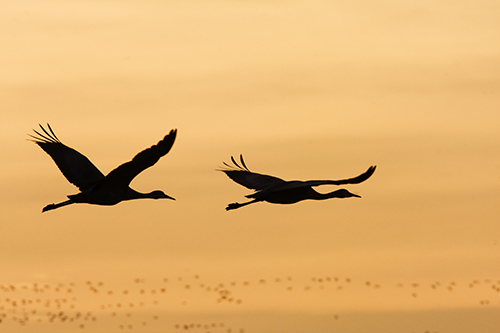
Of course I also could not resist doing a few silhouettes.

Silhouetted Sandhill Cranes Flying

Silhouetted Sandhill Cranes Flying

Silhouetted Sandhill Cranes Flying

Silhouetted Sandhill Cranes Flying


*If you are interested in purchasing any of the pictures displayed in this post, please check out my fine prints page for pricing.*
SLR Camera Trap Photography

Photographing wildlife with a SLR camera trap seems easy in concept. Place a camera trap in the wilderness, let it sit there, and have it take amazing pictures while you rest at home. This isn’t quite the case. One of the hardest parts about camera trap photography is getting your set-up to work like you want it to. The camera and flashes have to be ready to take a picture at moments notice, but need to also conserve batteries enough to last for an extended period of time. And then everything has to be safe in a serious down drench. Finally the biggest challenge of all is that you can’t buy professional camera traps at a store, ready to use out of the box. Even national geographic cameras use customized set-ups.

For inspiration, visit two of my favorite blogs. Chris Wemmer’s blog Camera Trap Codger which is not only filled with witty, educational, and fun writing but also accompanied by great camera trap images; as well as Jake Kirkland and Christian’s Camera Trapping Campus blog, filled with great stories and it hits close to home for me since I also got my degree from UCSC. All of them ‘hack’ much of their equipment to function for the camera trapping needs!

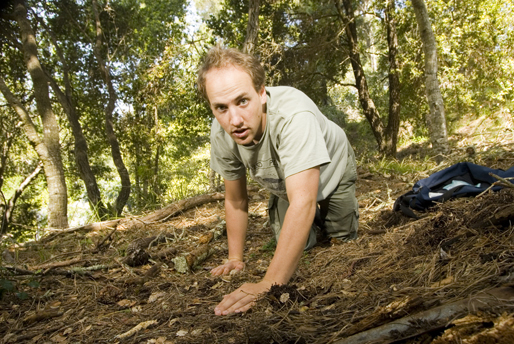
Once you have the equipment figured out the really fun part starts. Its time to hit the field to select your location for your camera trap. Natural game paths are always a perfect option, they provide ample chances for wildlife to walk by. During set-up, take the appropriate time since you can’t make any quick adjustments once the camera is in place. Using yourself always works:

Myself, getting some test shots in - reminder, comb your hair next time...

Myself, getting some test shots in – reminder, comb your hair next time…

After you are done setting up you want to leave it be, it will take a while for your smell to be masked by nature’s more natural smells and some time for the animals to get used to the new objects in their environment (don’t think they don’t know its there).

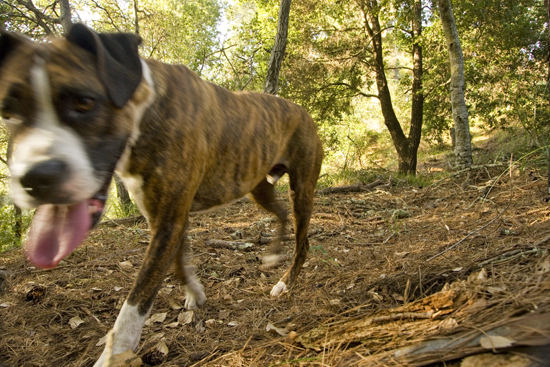
After some time you will get your first shots. In the beginning most likely just your neighbors pet:

Neighbors dog checking out the camera

Neighbors dog checking out the camera

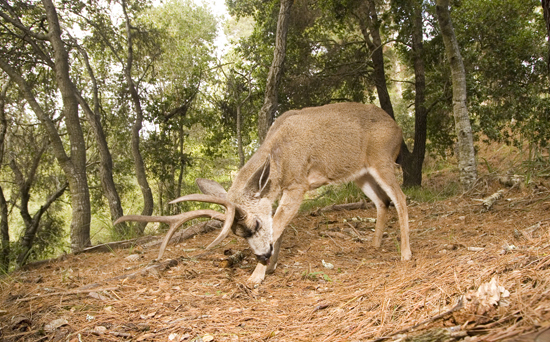
Maybe even some behavioral images:

Mule deer buck licking front leg

Mule deer buck licking front leg

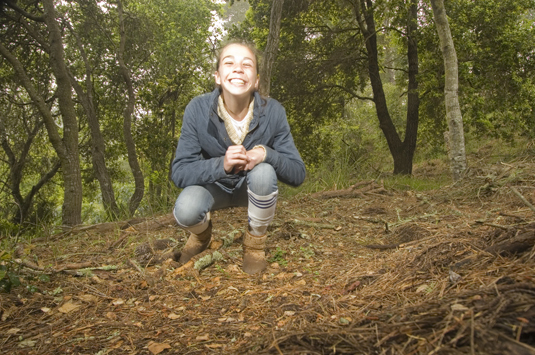
Of course many times you will get another curious human:

This one is having quite a lot of fun!

This one is having quite a lot of fun!

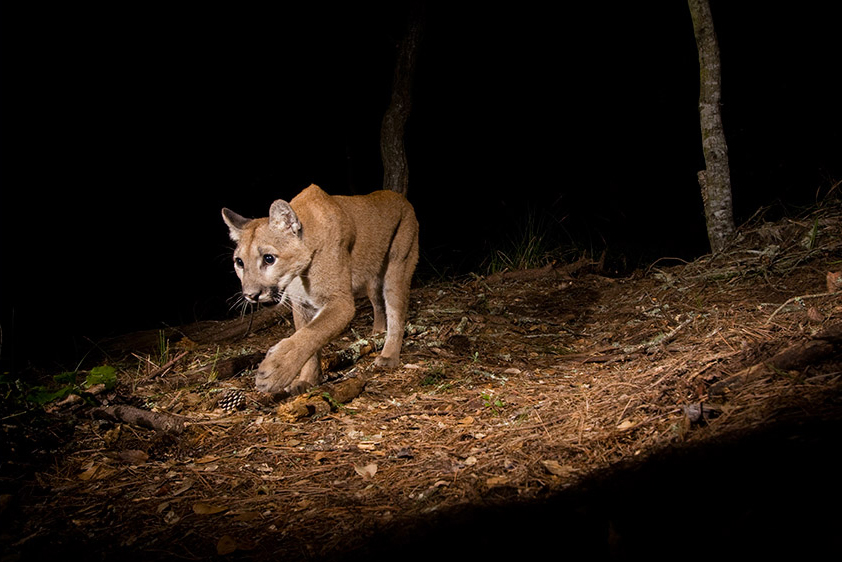
In the end though, when you get a shot like this, you are quite the happy camper:

Juvenile Mountain Lion at Night

Juvenile Mountain Lion at Night

Whenever you go to check the camera and replace batteries its like Christmas. You don’t know what you will get except a bunch of happy surprises. Camera trapping is a great way to get an intimate view into the lives of animals you may hardly see. It is something I very much cherish.

*If you are interested in purchasing any of the pictures displayed in this post, please check out my fine prints page for pricing.*